
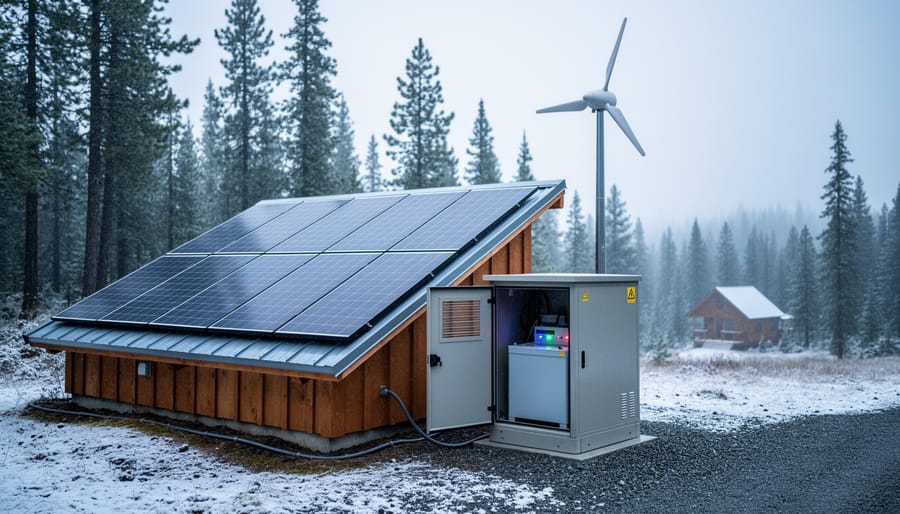
Off grid energy solutions combine solar panels, wind turbines, and battery storage to provide continuous electricity without connection to the utility grid. At their core, these systems harvest renewable energy during peak production hours, store excess power in deep-cycle batteries, and distribute electricity on demand through an inverter that converts DC power to standard AC current. For remote properties, environmental stewards, and Canadians seeking energy independence, the technology has matured significantly since 2020, with lithium battery costs dropping nearly 40% and solar panel efficiency climbing past 22% for residential installations.
The shift toward off-grid living reflects both practical necessity and intentional choice. Rural British Columbia alone hosts thousands of properties beyond economical grid extension range, where bringing in utility lines can cost $30,000 to $100,000 per kilometer. Meanwhile, growing numbers of urban and suburban Canadians are exploring these systems as backup solutions during increasingly frequent extreme weather events and as hedges against rising electricity rates.
Success hinges on accurate energy assessment and properly sized components. A typical off-grid home in Canada requires 15-30 kilowatt-hours daily, depending on heating systems, appliances, and seasonal sunlight variation. Winter presents particular challenges in northern climates, where December sunlight can deliver less than 20% of July’s solar production. Hybrid systems pairing solar arrays with small wind turbines or backup generators provide the reliability that single-source designs often lack.
Canadian manufacturers and installers have developed region-specific expertise, accounting for snow loads, extreme temperature swings, and the unique permitting requirements across provincial jurisdictions. This local knowledge transforms off-grid power from theoretical possibility into dependable reality.
Core Off Grid Energy Solutions for Remote Properties
Solar Power Systems
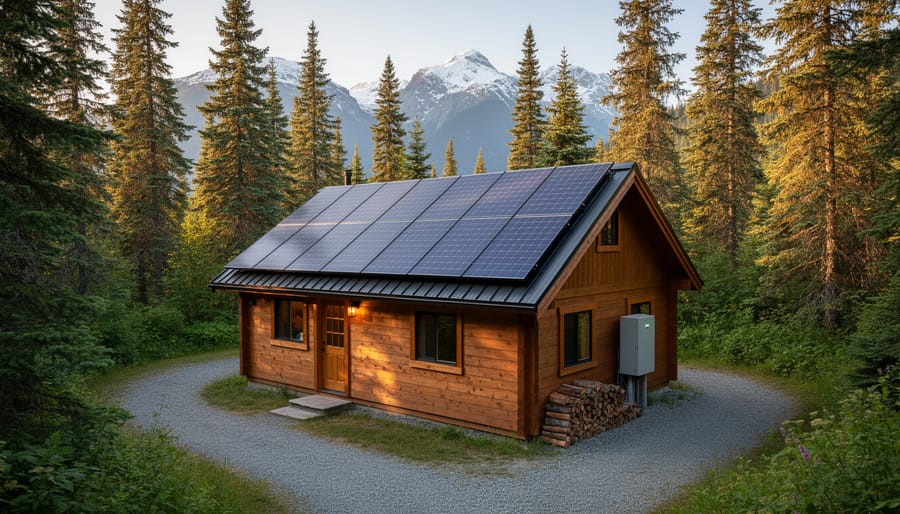
Photovoltaic panels convert sunlight directly into electricity through semiconductor cells, making them the most popular renewable technology for off-grid homes across BC. While BC’s reputation for rainfall might seem problematic, the province actually receives substantial solar radiation, coastal regions get 1,100-1,300 kWh/m²/year, while southern interior areas like the Okanagan reach 1,400-1,600 kWh/m²/year according to Canada PV solar maps. Modern panels maintain 15-22% efficiency even in diffuse light conditions common during BC’s overcast months.
A typical off-grid home requires 3-8 kW of solar capacity depending on energy consumption, translating to 10-25 panels. Systems must be oversized compared to grid-tied installations because they need to charge battery banks while simultaneously powering daytime loads. Unlike grid-connected solar farms that export excess generation, off-grid arrays pair with charge controllers that prevent battery overcharging and manage power flow between panels, batteries, and household circuits. This integration requires careful voltage matching, most residential systems operate at 24V or 48V DC before inverting to 120V/240V AC for standard appliances.
Small-Scale Wind Energy
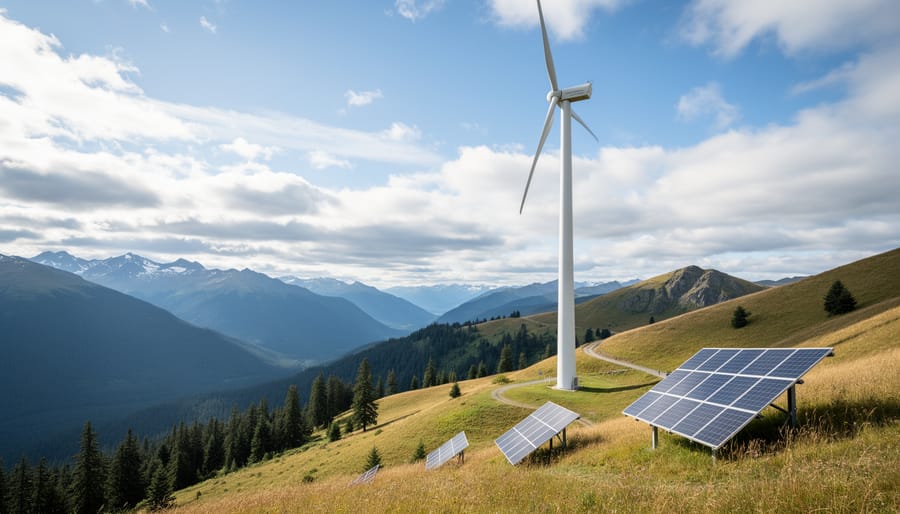
Small-scale wind turbines offer complementary generation for off-grid properties, particularly in BC’s windswept coastal regions and elevated mountain passes where consistent breezes are common. Residential units typically range from 400 watts to 10 kilowatts, with 1-3 kW systems proving popular for supplementing solar arrays. Coastal islands, exposed ridgelines, and inland valleys experiencing frequent thermal winds present ideal conditions, locations needing average wind speeds above 4 metres per second for viable output.
Wind excels during BC’s cloudier fall and winter months when solar production dips, creating a natural seasonal balance. The Small wind guidebook recommends thorough wind-resource assessment before installation, as turbulent airflow near trees or buildings dramatically reduces efficiency. Expect higher upfront costs than equivalent solar capacity, roughly $4,000, $8,000 per kilowatt installed, but substantially better winter performance in windy BC microclimates. Hybrid solar-wind systems hedge against seasonal variability, ensuring more consistent battery charging year-round.
Micro-Hydro Power
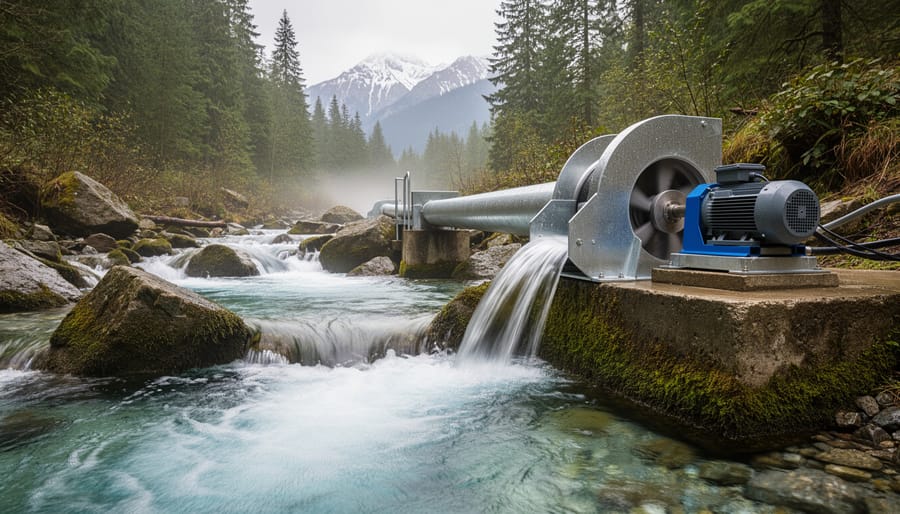
BC’s abundance of year-round creeks and streams makes micro-hydro one of the most reliable off-grid power sources available. Run-of-river systems divert a portion of flowing water through a penstock pipe to a turbine, generating electricity without requiring a dam or large reservoir. Even small installations, capturing as little as 10-50 litres per second with modest elevation drop, can produce 1-5 kW continuously, often meeting an entire off-grid home’s baseload power needs.
Unlike solar and wind, micro-hydro generates consistently day and night, making it ideal for BC’s wet coastal and interior regions where many streams maintain flow through winter. The Run-of-river BC guide details site assessment and design considerations specific to provincial watersheds.
Regulatory requirements include water licensing through the provincial comptroller, environmental assessments for fish passage, and potentially federal Fisheries Act authorization if you’re diverting navigable water. These approvals take time but protect BC’s salmon-bearing streams while allowing sustainable private power generation. Properly designed systems require minimal maintenance, clearing intake screens seasonally and occasional turbine servicing, and can operate reliably for decades.
Biomass and Backup Generators
Biomass and backup generators fill critical gaps when solar panels sit under snow and wind turbines stall in still air. Wood gasification systems convert dry cordwood into combustible gas, generating electricity while producing heat, practical for forested BC properties with abundant deadfall. A typical 10-kW gasifier runs six to eight hours on a cord of wood, delivering reliable power during multi-day storms.
Biodiesel generators offer another layer of security, burning renewable fuel from canola or waste vegetable oil. Modern inverter generators sip fuel efficiently, running only when battery banks drop below set thresholds. Propane generators remain the most common backup choice, clean-burning, long-storing fuel that starts reliably at -30°C, essential insurance for BC’s interior winters when primary renewables can’t keep pace with heating and lighting demands.
Energy Storage: The Critical Component
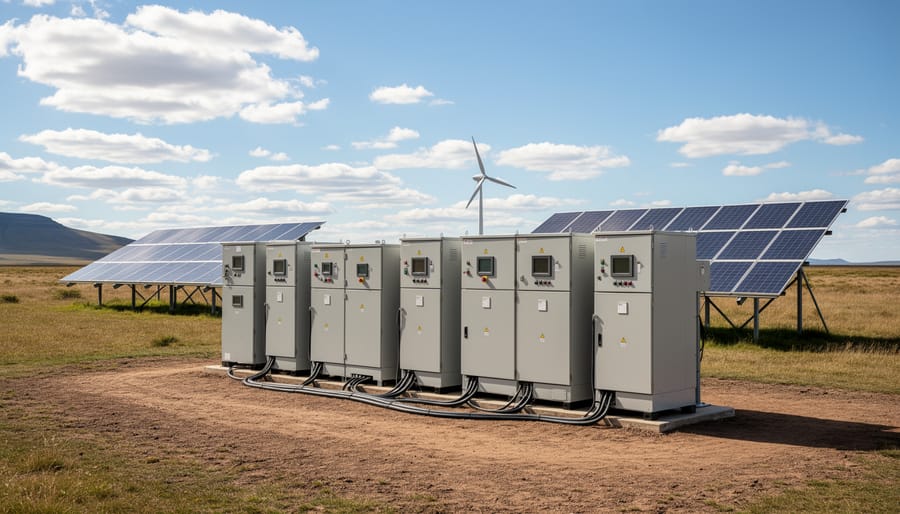
Without battery storage, even the most robust solar array or wind turbine becomes unreliable the moment the sun sets or the wind drops. Storage transforms intermittent renewable generation into dependable 24/7 power, making it the backbone of any serious off-grid energy system.
Battery Technologies for Off-Grid Applications
Lithium-ion batteries have become the dominant choice for modern off-grid installations. They deliver 80-90% depth of discharge (meaning you can use most of their capacity without damage), cycle 3,000-5,000 times, and require virtually no maintenance. A 10 kWh lithium battery bank can power essential loads through several cloudy days in BC’s coastal climate. The upfront cost runs higher than alternatives, but the longevity and usable capacity often justify the investment for permanent off-grid homes.
Lead-acid batteries, both flooded and sealed AGM variants, remain common in budget-conscious or legacy systems. Flooded lead-acid costs roughly half what lithium does per kilowatt-hour but accepts only 50% depth of discharge and cycles 500-1,000 times before replacement. They need regular maintenance, monthly water top-ups for flooded types, and proper ventilation. Still, for weekend cabins or systems where initial cost matters most, lead-acid delivers proven reliability.
| Battery Type | Lifespan (Cycles) | Approximate Cost/kWh | Best Applications | Maintenance |
|---|---|---|---|---|
| Lithium-ion | 3,000-5,000 | $800-1,200 | Year-round homes, high daily use | Minimal |
| Flooded Lead-Acid | 500-1,000 | $200-400 | Seasonal cabins, budget systems | Monthly checks, watering |
| AGM Lead-Acid | 800-1,500 | $400-600 | Moderate use, sealed environments | Low, no watering |
| Flow Batteries | 10,000+ | $1,000-1,500 | Large-scale, commercial off-grid | Moderate, electrolyte management |
Flow batteries and other emerging technologies show promise for larger installations. Vanadium redox flow batteries cycle tens of thousands of times and scale easily, but their size and complexity suit community-scale projects more than individual homes.
Sizing Your Storage Capacity
Calculate storage needs by tallying your daily energy consumption in kilowatt-hours, then multiply by the number of autonomy days you want (typically three to five days for BC’s winter weather patterns). A home using 15 kWh daily would need 45-75 kWh of usable storage for three to five days of backup. Factor in depth of discharge: that same 75 kWh usable requires 83 kWh of lithium-ion (90% DoD) or 150 kWh of lead-acid (50% DoD).
Proper battery management systems prevent overcharging, balance cells, and extend lifespan regardless of chemistry. In BC’s temperature extremes, from coastal humidity to interior cold snaps, housing batteries in a climate-controlled space protects performance and longevity.
Designing Your Off Grid Energy System
Designing an effective off-grid energy system starts with honest calculation of your daily power consumption. List every device you’ll run, lights, refrigerator, water pump, electronics, heating controls, and note their wattage and daily runtime. Most off-grid homes in BC use between 3 and 10 kilowatt-hours daily, significantly less than grid-connected properties, because energy consciousness becomes second nature when you generate your own power.
Once you know your consumption, add a 25-30% buffer for inefficiencies and future growth, then size your generation capacity to meet this demand even during your location’s worst renewable energy months. In coastal BC, that typically means December and January with minimal sun and variable wind. Interior locations face cold that reduces battery efficiency but often enjoy clearer winter skies. Your system must produce enough during these lean periods, or you’ll drain your batteries and need backup generation.
Battery storage is where most people underestimate. A common mistake is sizing storage for just one or two days of autonomy, but BC’s coastal rainforests can see five to seven consecutive overcast days in winter. Calculate your daily consumption, multiply by your desired days of autonomy (three to five days minimum for reliability), then factor in your battery’s recommended depth of discharge. If you need 30 kWh of usable storage and use lithium batteries at 80% depth of discharge, you’ll need roughly 37.5 kWh of rated capacity.
Integrating multiple energy sources creates resilience. A hybrid system combining solar panels with a small wind turbine or micro-hydro installation means you’re never entirely dependent on one resource. When coastal fog blankets your solar array, wind often picks up. When summer droughts reduce stream flow for your micro-hydro, longer days boost solar production. Canadian renewable tech advances have made these hybrid controllers and inverters more sophisticated and affordable, automatically managing power from multiple sources without manual intervention.
Climate-specific considerations matter enormously in BC. Coastal installations need corrosion-resistant mounting hardware and must account for frequent rain reducing solar output. Interior systems require cold-weather battery enclosures and panel mounts engineered for heavy snow loads. Northern BC locations benefit from exceptional summer solar resource but need larger battery banks to bridge the long winter nights.
Work with experienced off-grid installers familiar with your specific region, they’ll understand local weather patterns, permitting requirements, and proven equipment combinations that match BC’s diverse conditions. A properly designed system tailored to your location and usage patterns will provide decades of reliable, independent power.
Costs, Incentives, and Return on Investment
Understanding the financial picture helps you make informed decisions about going off-grid. A basic solar setup for a small cabin typically starts around $15,000 to $25,000, covering panels, inverters, batteries, and installation. Larger residential systems for year-round living range from $40,000 to $80,000, depending on energy needs and whether you integrate wind or micro-hydro components. These figures often prove competitive with extending grid service to remote properties, where connection costs can exceed $50,000 for locations more than a kilometre from existing infrastructure.
Canadian and BC programs reduce upfront investment considerably. Current incentives include:
- Federal Greener Homes Grant providing up to $5,000 for eligible renewable energy systems
- BC Hydro’s Indigenous and Remote Community Solar Programs offering technical support and funding
- Canada Greener Homes Loan up to $40,000 at zero percent interest
- Provincial Sales Tax exemption on qualifying solar, wind, and micro-hydro equipment
- Investment tax credits through federal clean technology programs
Consulting your local renewable energy association helps identify current offerings, as programs evolve annually and new regional initiatives emerge.
Payback periods vary significantly based on system size, energy usage, and whether you are offsetting grid connection costs or replacing generator fuel expenses. Properties avoiding $50,000 grid extensions see immediate payback on comparable off-grid investments. For fuel replacement scenarios, realistic payback spans seven to fifteen years through eliminated diesel or propane costs averaging $300 to $600 monthly. Battery replacement every ten to fifteen years represents the main ongoing expense, typically $8,000 to $15,000.
Beyond pure financial returns, off-grid systems offer energy security, independence from rate increases, and environmental benefits that matter to many BC property owners. Those interested in renewable energy investing increasingly view off-grid installations as both lifestyle choices and long-term value propositions, particularly as technology costs continue declining while grid extension expenses rise.
BC Success Stories: Off Grid Energy in Action
British Columbia’s diverse geography has spawned equally diverse off-grid success stories, proving these systems work in real-world conditions far removed from laboratory ideals.
On Cortes Island, the Hollyhock retreat centre runs entirely on solar arrays paired with lithium battery banks, powering workshops, kitchens, and accommodations for hundreds of visitors annually. Their 40kW solar installation generates surplus power during summer months, which they bank through net metering agreements with neighbouring properties. The key lesson: oversizing solar capacity relative to winter demand eliminates the anxiety of dark December weeks.
In the Kootenay region, the Argenta Co-housing community demonstrates small-scale hydro potential. Fifteen households share a 12kW micro-hydro system drawing from a year-round creek, supplemented by individual solar panels on each home. This hybrid approach provides baseload power from water while solar handles daytime peaks. Residents report the creek system has run continuously for eight years with minimal maintenance beyond seasonal debris clearing.
The Gulf Islands showcase another model. A Pender Island family combined a 5kW wind turbine with solar panels after calculating their exposed hilltop location generated consistent winds from fall through spring, precisely when solar production drops. Their system includes a diesel generator that runs fewer than 30 hours yearly, reserved for equipment requiring high surge currents.
Mountain applications face harsher tests. A Revelstoke backcountry lodge relies on solar panels mounted at steep angles to shed snow, paired with a small hydro system during snowmelt months. Winter guests now expect reliable power for lights and communication equipment, dispelling the myth that remote necessarily means primitive.
These installations share common threads: realistic load calculations, oversized storage capacity, and willingness to modify consumption patterns during extreme weather. Each household reports the learning curve lasts one to two years before energy management becomes intuitive.
Common Questions About Off Grid Energy Solutions
Can off grid energy solutions really work through BC winters?
Yes, with proper system sizing and adequate battery storage. Solar production drops significantly during winter months, but wind often picks up when solar wanes, and micro-hydro maintains consistent output year-round in most BC streams.
How much maintenance do off grid energy systems require?
Expect 10-20 hours annually for most systems: clearing snow from panels, checking battery water levels (for lead-acid), inspecting wind turbine bearings, and cleaning micro-hydro intake screens. Professional servicing is recommended every 2-3 years.
What permits do I need for off grid energy in British Columbia?
Solar installations typically require building permits but not electrical permits if under 5kW. Wind turbines need development permits in most municipalities. Micro-hydro requires water licenses from the BC Comptroller of Water Rights, even for small installations on your property.
How long do off grid energy systems last?
Solar panels carry 25-year warranties and often produce for 30+ years. Wind turbines last 15-20 years with proper maintenance. Battery banks need replacement every 5-15 years depending on technology and usage patterns.
The permitting landscape surprises many first-timers. Beyond the water rights mentioned above, you’ll need to work with your regional district for setback requirements on wind turbines and confirm your property’s zoning allows power generation equipment. Some areas restrict turbine height or noise levels, particularly near residential neighbours.
Internet and communications present less challenge than most assume. Starlink and similar satellite services draw 50-100 watts, manageable within most off-grid budgets. Cell boosters add another 5-10 watts. The real power hogs are electric vehicle charging and shop tools, budget accordingly if these matter to your lifestyle.
Is off-grid living right for you? It demands a different mindset. You’ll monitor battery levels, adjust usage during cloudy stretches, and occasionally fire up a backup generator. Those who thrive off-grid tend to enjoy the technical engagement and appreciate the energy awareness it builds. If you want to flip switches without thought, staying grid-connected makes more sense, even if it costs more upfront to extend service.
The lifestyle works particularly well for weekend retreats, retirement properties where you’re home to manage systems, and households with at least one technically inclined member. Families with young children often wait until kids are older before tackling the learning curve, though many BC families manage successfully from the start.
Off-grid energy solutions have evolved from experimental setups into reliable, cost-effective systems that make remote living genuinely viable across British Columbia and beyond. The combination of mature solar and wind technologies, advanced battery storage, and BC’s abundant renewable resources, from coastal winds to interior sunshine to year-round streams, creates unprecedented opportunities for energy independence.
Technology costs have dropped substantially over the past decade while efficiency has improved, narrowing the financial gap between off-grid systems and extending utility lines to remote properties. Provincial incentives and federal programs further improve the economics, and environmental benefits add value that traditional grid connections simply can’t match.
Whether you’re planning a mountain retreat, coastal homestead, or rural property without grid access, today’s off-grid energy technologies offer practical solutions tailored to BC’s diverse climates and terrain. Start by calculating your actual energy needs, consider which renewable sources best suit your location, and factor in realistic storage requirements for seasonal variations.
Connect with BC-based renewable energy professionals who understand local conditions, permitting requirements, and proven system designs for our province’s unique challenges. The path to energy independence is clearer and more accessible than ever before.