
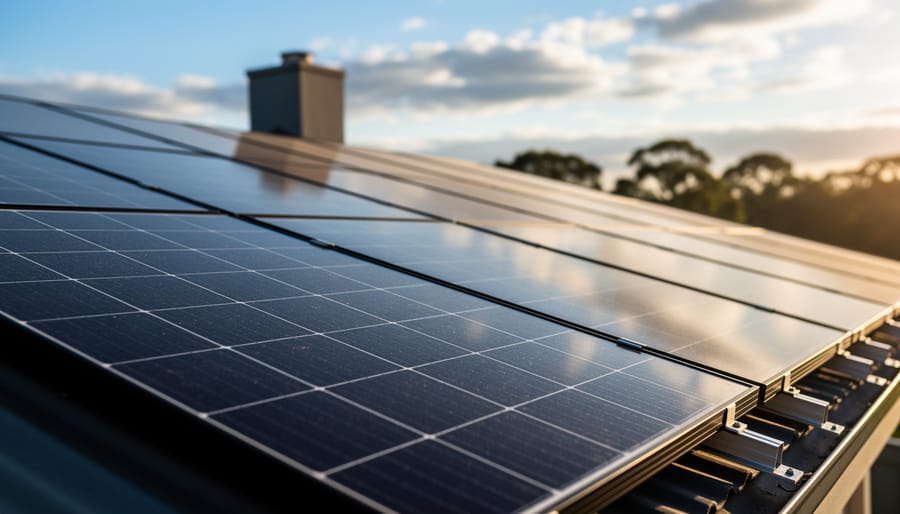
Solar panels convert sunlight into electricity through the photovoltaic effect, a process where semiconductor materials (typically silicon) generate an electrical current when photons strike their surface. This quantum mechanical phenomenon forms the foundation of solar technology, transforming solar energy into usable power with no moving parts, no emissions, and minimal maintenance requirements.
The elegance lies in simplicity. When sunlight hits a solar cell, it knocks electrons loose from silicon atoms. An electric field built into the cell’s structure directs these free electrons into a current, which metal contacts on the cell’s surface collect and channel into wires. String multiple cells together into a panel, connect several panels into an array, and you’ve created a power plant on your roof.
Understanding this technology matters now more than ever. Canadian installations have surged across residential and commercial properties, driven by improving efficiency rates, falling costs, and grid integration capabilities that make solar viable even during our shorter winter days. The technology has also expanded beyond rooftops, with innovations like offshore solar farms demonstrating the versatility of photovoltaic systems in diverse environments.
But efficiency varies dramatically based on panel type, installation angle, temperature, and local climate factors. A homeowner in Vancouver faces different performance variables than someone in Winnipeg. Getting solar technology right requires understanding not just how the panels work, but how all system components interact with your specific environment and electrical setup.
The Science Behind Solar Panels: Photovoltaic Effect Explained
Solar panels work through the photovoltaic effect, a phenomenon where light particles (photons) strike a semiconductor material and free electrons, creating an electrical current. Think of it like a microscopic version of Newton’s cradle: incoming photons knock electrons loose, and those freed electrons flow in one direction to create usable electricity.
The heart of this process is silicon, the same material found in computer chips. Solar cells use specially treated silicon that creates an internal electric field. Manufacturers “dope” silicon with tiny amounts of other elements to create two distinct layers: one with extra electrons (n-type) and one with electron “holes” (p-type). Where these layers meet, an electric field forms naturally, similar to how opposite poles of magnets create an invisible force between them.
When sunlight hits the silicon, photons transfer their energy to electrons in the material. If a photon carries enough energy (which visible and ultraviolet light do), it breaks the electron’s bond with its silicon atom. The electric field at the junction immediately pushes these freed electrons toward the n-type layer and pulls the resulting “holes” toward the p-type layer. This organized movement of charged particles is electric current.
Each silicon cell generates only about 0.5 volts, so manufacturers connect dozens of cells in series within a panel to reach useful voltages around 30-40 volts. The electricity produced is direct current, flowing in one direction from the panel, which is why solar systems need inverters to convert it to the alternating current your home uses.
Core Components of Modern Solar Panel Systems
Solar Cells and Panel Construction
Solar cells are the fundamental building blocks where sunlight-to-electricity conversion happens. Most residential panels use silicon-based cells, but the manufacturing process creates distinct types with different performance profiles.
Monocrystalline cells are cut from a single, continuous silicon crystal, giving them their characteristic uniform dark appearance. This pure structure allows electrons to flow more freely, delivering efficiency ratings of 18-22% in typical residential panels. They perform slightly better in low-light conditions and occupy less roof space for the same power output, though they command a higher price point.
Polycrystalline cells are formed by melting multiple silicon fragments together, creating a mosaic-like blue appearance. The crystal boundaries impede electron movement somewhat, resulting in 15-18% efficiency. They’re less expensive to manufacture but require more surface area to match monocrystalline output.
Thin-film panels use layers of photovoltaic material deposited on glass or metal substrates. While their 10-13% efficiency trails crystalline options, they’re lightweight, flexible, and perform more consistently in heat or partial shade. You’ll find them in specialized applications like building-integrated installations.
Individual cells, typically 60 or 72 in residential panels, are soldered together in series to build voltage, then laminated between protective glass and backsheet materials. This weatherproof construction creates the familiar framed panel that mounts to your roof, rated to withstand decades of Canadian weather exposure.
Inverters: Converting DC to AC Power
Solar panels produce direct current (DC) electricity, but your home appliances run on alternating current (AC). The inverter bridges this gap by converting DC into the standard 120/240-volt AC that matches your household wiring and the Canadian electrical grid.
String inverters connect multiple panels in series to a single central unit. They’re cost-effective for simple installations where shading isn’t a concern, but one poorly-performing panel can drag down the entire string’s output.
Microinverters attach to each individual panel, converting DC to AC right at the source. This setup prevents one shaded panel from affecting others and allows panel-level monitoring, though it costs more upfront. They excel on roofs with multiple orientations or partial shade issues.
Power optimizers offer a middle ground: they condition DC power at each panel before sending it to a central inverter. You get panel-level optimization and monitoring at a lower price point than microinverters, making them popular for Canadian residential installations where roof complexity varies but budget matters.
Modern inverters also handle grid synchronization, voltage regulation, and safety shutoffs during power outages, making them far more sophisticated than simple current converters.
Mounting Systems and Racking
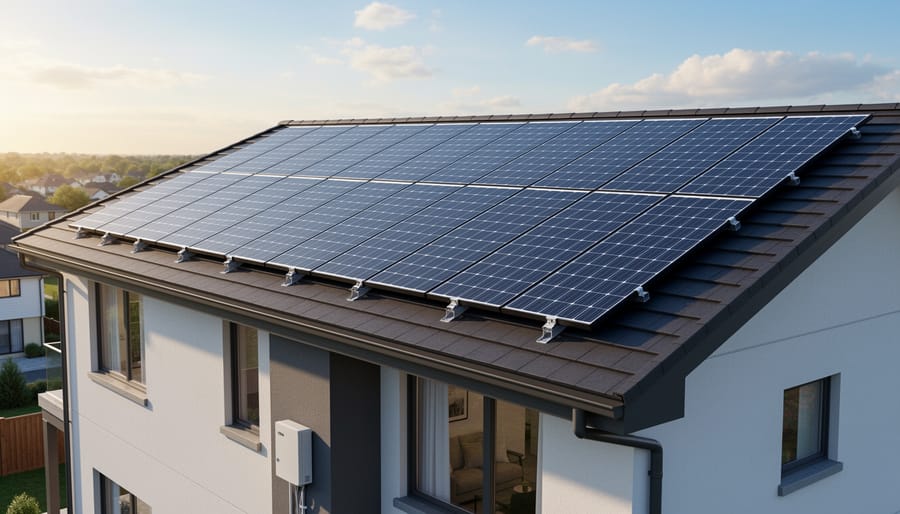
Solar panels require robust mounting infrastructure to withstand decades of exposure while maintaining optimal positioning. The racking system consists of aluminum or stainless steel rails that attach to roof penetration points or ground-mounted footings, providing the structural framework that holds panels at the correct angle.
Attachment hardware varies by installation type. Roof mounts use lag bolts secured into rafters, sealed with flashing to prevent water infiltration. Ground mounts employ concrete footings or helical piles driven deep enough to resist frost heave, a critical consideration in Canadian climates where freeze-thaw cycles can shift inadequately anchored systems.
Rail-mounted clamps secure individual panels without drilling through the glass or frame, allowing thermal expansion while maintaining electrical grounding. In regions with heavy snow loads, engineers specify higher rail profiles and reinforced mounting points to handle additional weight. Wind uplift calculations determine spacing between attachment points, ensuring panels remain secure during storms without over-penetrating roofing materials and compromising weatherproofing integrity.
Efficiency Factors in Solar Panel Performance
Temperature Coefficients and Seasonal Variations
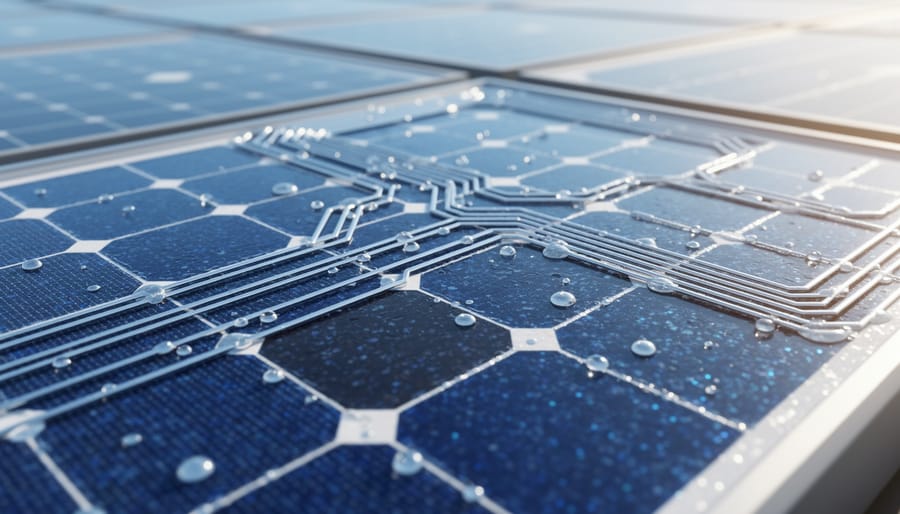
Canadian winters create one of solar technology’s most surprising performance characteristics. While intuition suggests cold reduces output, solar panels actually operate more efficiently in lower temperatures. The key lies in understanding temperature coefficients, the rate at which a panel’s voltage decreases as temperature rises.
Most crystalline silicon panels lose about 0.3% to 0.5% efficiency for every degree Celsius above 25°C. On a summer day when rooftop panels reach 65°C, that translates to a 12-20% reduction in rated output. Conversely, cold winter days with bright sunshine can push panels above their nameplate capacity. A panel rated at 400 watts might produce 420 watts when operating at -10°C under full sun.
Canada’s seasonal patterns create distinct performance curves. Winter months deliver fewer daylight hours but can achieve peak efficiency during clear, cold days. Snow cover presents the main winter challenge, though steep-angled installations shed accumulation quickly, and reflective properties from surrounding snow can boost overall light capture.
Summer provides longer production windows despite heat-related efficiency losses. The extended daylight compensates for the temperature penalty, making June through August typically the highest-producing months even as individual peak performance occurs on crisp winter days.
Degradation Rates and Long-Term Output
Modern solar panels degrade at approximately 0.5% to 0.8% per year, meaning a panel will typically retain about 85-90% of its original capacity after 25 years. This predictable decline is factored into industry-standard warranties, which usually guarantee at least 80% output at year 25.
Most manufacturers offer tiered warranties: a product warranty covering defects (typically 10-12 years) and a separate performance warranty guaranteeing minimum output levels. Premium panels from established manufacturers often promise 90% output at 10 years and 80% at 25 years, while budget options may guarantee only 80% at 25 years without intermediate milestones.
For investment calculations, this degradation pattern means a 6-kilowatt system producing 7,200 kilowatt-hours annually in year one will generate roughly 6,120 kilowatt-hours in year 25. When modeling financial returns, use the manufacturer’s specific degradation rate rather than assuming all panels decline equally. Higher-quality panels with lower degradation rates often justify their premium cost through superior long-term production, especially in Canadian climates where temperature cycling can accelerate wear on inferior products.
Energy Storage and Grid Integration Technologies
Solar panels only generate electricity when the sun shines, but most homes need power around the clock. Energy storage and grid integration technologies bridge this gap, letting you use solar power after sunset or during cloudy periods.
Battery Storage Systems
Lithium-ion batteries dominate residential solar storage, storing excess daytime generation for evening use. These systems typically range from 10-20 kWh capacity for a Canadian home, enough to cover essential loads overnight or during brief outages. Lithium iron phosphate (LFP) chemistry has gained traction in cold climates due to superior safety and performance at low temperatures compared to standard lithium-ion variants. Lead-acid batteries remain an option for budget-conscious installations or off-grid solar solutions though their shorter lifespan and lower depth-of-discharge make them less economical over time.
Grid-Tied Configurations
Most Canadian solar installations connect to the utility grid through net metering programs. When your panels produce more than you consume, excess electricity flows back to the grid, spinning your meter backward and earning credits. At night, you draw from the grid using those credits. This arrangement eliminates the need for batteries in many cases, with the grid effectively acting as infinite storage. Provincial programs vary, Ontario’s net metering caps system size at 500 kW, while BC allows systems up to 100 kW for residential properties.
Hybrid System Designs
Hybrid systems combine batteries with grid connection, offering backup power during outages while maintaining net metering benefits. Smart inverters automatically switch between solar generation, battery discharge, and grid power based on real-time conditions and electricity rates. Time-of-use optimization charges batteries when rates are low and discharges during peak-price hours, maximizing savings beyond simple solar offset. These configurations prove especially valuable in provinces with significant rate variation between on-peak and off-peak periods.
Monitoring and Smart Solar Technology
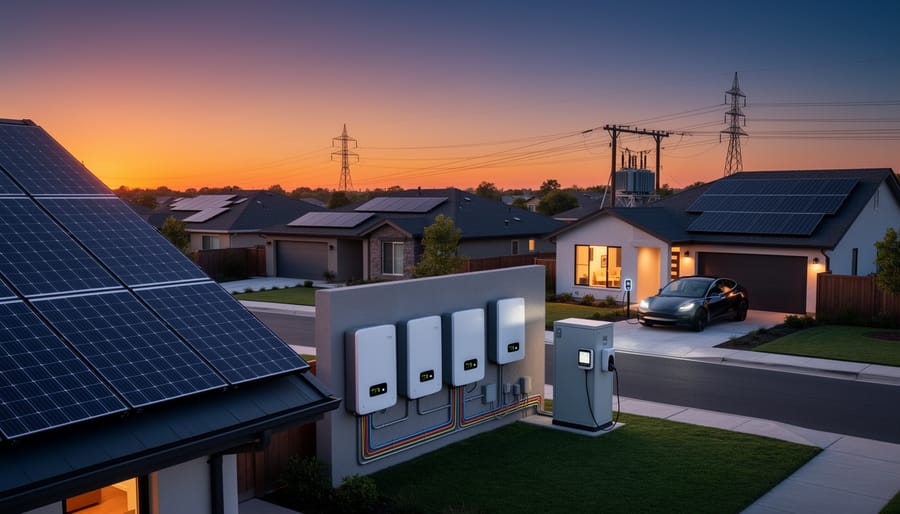
Modern solar installations come equipped with sophisticated monitoring systems that turn your panels into a connected energy platform. These systems track production in real-time, alert you to performance issues, and provide detailed insights into your system’s efficiency, all through smartphone apps or web dashboards.
Most manufacturers include monitoring as standard equipment, either through inverter-integrated software or third-party platforms. You’ll see instantaneous power generation, daily and monthly production totals, and historical comparisons that reveal seasonal patterns. The granular data helps identify underperforming panels, shading issues, or equipment problems before they significantly impact your output. Some systems break down production by individual panel when paired with microinverters or power optimizers, making troubleshooting straightforward.
Smart inverters take monitoring further by communicating with the electrical grid. These devices can adjust output during peak demand periods when utilities need additional supply, participate in demand response programs that offer financial incentives, and maintain grid stability by regulating voltage and frequency. In Canadian provinces with time-of-use electricity rates, smart systems can optimize when stored battery power gets deployed versus feeding excess generation to the grid, maximizing the economic value of your installation.
Advanced platforms integrate weather forecasting to predict tomorrow’s production, calculate your environmental impact in terms of carbon offset, and even benchmark your system against similar installations in your region. This transparency transforms solar from a passive technology into an actively managed energy asset.
Common Questions About Solar Panel Technology
Solar panels represent a significant investment, and prospective buyers naturally have questions about how the technology will perform in their specific situation. Here are answers to the most common technical concerns we encounter from Canadian homeowners and investors.
How long do solar panels actually last?
Modern solar panels typically maintain 80-85% of their original output after 25 years, with many continuing to produce electricity for 30-40 years. The inverter usually requires replacement after 10-15 years, while the panels themselves have no moving parts to wear out.
Do solar panels need regular cleaning?
In most Canadian climates, rain provides sufficient cleaning, and manual washing is rarely necessary. Snow typically slides off angled panels or melts quickly due to the dark surface absorbing heat, though persistent ice buildup may temporarily reduce output during winter months.
Will solar panels work with my home’s existing electrical system?
Solar installations integrate with standard residential electrical panels through a dedicated circuit breaker. Your installer will assess whether your main panel has capacity or requires an upgrade, and ensure the system meets local electrical codes.
Can I expand my solar system later?
Systems designed with expansion in mind can accommodate additional panels if your roof has space and the inverter has spare capacity. Planning for future growth during initial installation makes upgrades simpler and more cost-effective than retrofitting later.
One question we hear frequently relates to solar DIY installation versus professional setup. While the components themselves are straightforward, proper installation requires electrical expertise, structural assessment for roof mounting, and familiarity with local permit requirements and utility interconnection procedures. Most jurisdictions require licensed electricians for grid-tied systems to ensure safety and code compliance.
Understanding how solar panels work, from the photovoltaic effect in individual cells to the inverters and monitoring systems that complete a modern installation, removes the mystery from what many perceive as complex technology. The science is straightforward: semiconductors generate electrical current when struck by photons, and proven engineering converts that current into the power running your appliances.
This knowledge matters because solar installations represent significant investments, and informed decisions require more than marketing claims. Knowing that monocrystalline panels deliver higher efficiency but cost more, or that cold Canadian winters can actually boost performance when sunlight hits properly oriented panels, lets you evaluate quotes and system designs with confidence.
Today’s photovoltaic systems aren’t experimental. They’re mature, reliable technology backed by 25-year warranties and predictable degradation rates. Yet innovation continues, perovskite tandems promise higher efficiency, bifacial panels capture reflected light, and smarter inverters optimize every watt. For Canadian homeowners and those looking to invest in solar these aren’t distant possibilities but current options worth exploring.
The fundamentals covered here apply whether you’re sizing a residential rooftop system or assessing renewable portfolios. Solar technology works, the economics increasingly favor adoption, and understanding the mechanics ensures you’re equipped to make that choice wisely.