
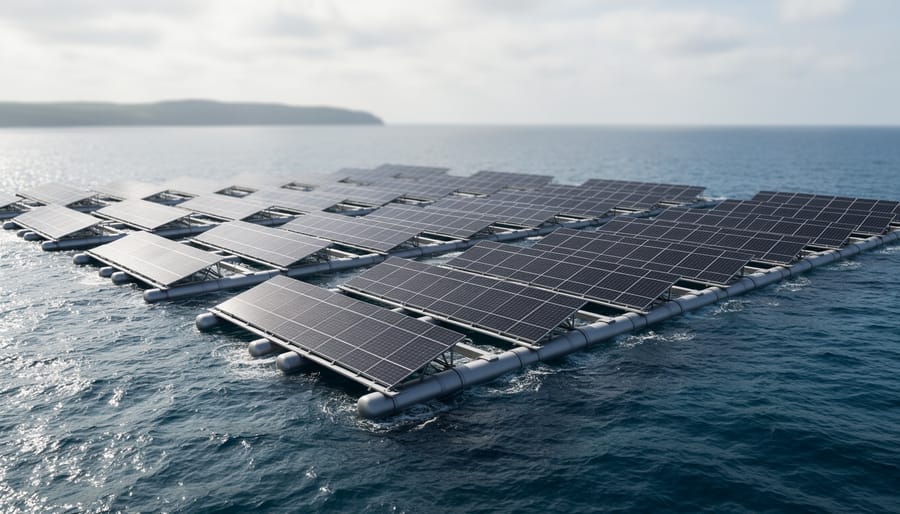
Offshore solar farms are large-scale photovoltaic arrays installed on bodies of water, typically oceans or large inland lakes, designed to generate electricity while addressing land scarcity and benefiting from natural cooling effects that improve panel efficiency. This technology represents a practical evolution of floating solar systems, combining the proven principles of traditional solar energy with the unique advantages of marine environments.
As renewable energy demand accelerates and available land becomes more contested, offshore solar offers a compelling alternative that doesn’t compete with agriculture, urban development, or conservation efforts. The concept has moved beyond pilot projects in 2026, with multiple countries now testing commercial-scale installations that could significantly expand solar capacity without requiring vast terrestrial footprints.
The appeal is straightforward. Water-based solar systems can tap into underutilized marine areas, particularly near coastal population centers where energy demand is highest and transmission distances remain manageable. The ocean’s cooling effect on panels can boost efficiency by 5 to 10 percent compared to land-based counterparts, while the proximity to offshore wind infrastructure opens possibilities for hybrid renewable installations that share grid connections and maintenance resources.
This article explains how offshore solar farms function, the different system designs being deployed, where they make the most sense, and the practical challenges that will shape their future. Whether these installations become a cornerstone of coastal energy grids or remain a specialized solution for specific geographies depends on solving real engineering and economic hurdles that go beyond the technology itself.
What Are Offshore Solar Farms?
Offshore solar farms represent a frontier in the renewables transition placing photovoltaic technology on water rather than land. These installations mount solar panels on floating platforms, fixed structures, or hybrid systems positioned in oceans, lakes, reservoirs, and other large bodies of water. The approach addresses land scarcity in densely populated regions while taking advantage of water’s cooling effect, which can improve panel efficiency by up to 10% compared to land-based arrays.
The technology breaks down into distinct categories based on location and installation method:
- Floating Photovoltaic Systems (FPV)
- Solar arrays mounted on buoyant platforms that sit directly on water surfaces, most commonly deployed on reservoirs and lakes. These modular systems can cover a portion of a water body while maintaining access for other uses.
- Marine Solar Arrays
- Ocean-based installations designed to withstand saltwater corrosion, wave action, and stronger weather conditions than inland systems. They’re typically deployed in protected coastal waters or further offshore on stabilized platforms.
- Hybrid Renewable Platforms
- Combined wind-solar installations that share maritime infrastructure, transmission cables, and grid connections, maximizing energy generation per square kilometre of ocean space.
Ocean-based offshore solar farms face harsher conditions than their lake and reservoir counterparts, requiring specialized materials and anchoring systems to handle waves, saltwater exposure, and marine growth. Inland floating systems benefit from calmer water and easier maintenance access, making them the more established option globally. Countries like China and Japan have rapidly deployed floating solar on reservoirs, while true ocean installations remain largely experimental, with pilot projects testing durability and performance in marine environments.
The distinction matters because regulatory frameworks, environmental considerations, and engineering requirements differ substantially between calm inland waters and dynamic ocean settings.
How Offshore Solar Farms Work
Energy Collection and Conversion
Offshore solar panels operate on the same photovoltaic principle as their land-based counterparts, semiconductor materials within each cell absorb photons from sunlight, knocking electrons loose to create direct current electricity. When sunlight strikes the panel’s surface, the photovoltaic cells generate voltage across their layers, and this DC power flows through wiring to inverters that convert it to alternating current suitable for grid transmission.
What sets offshore installations apart is their operating environment. Floating on water provides a significant thermal advantage: the panels run cooler than they would on hot rooftops or sun-baked fields. Solar cells lose efficiency as they heat up, typically about 0.5% per degree Celsius above 25°C, so the moderating effect of water below can meaningfully improve output. Studies confirm that water cooling boosts efficiency compared to similar panels on land, with some installations showing 5-10% higher generation during peak summer months.
The water surface itself enhances performance in another way: sunlight reflecting off the water can reach the underside of bifacial panels (those designed to capture light from both sides), adding a modest bump to total energy capture. Combined, these factors mean offshore arrays often produce more electricity per installed watt than equivalent land systems, despite the added complexity of marine deployment.
Grid Connection and Power Transmission
Once solar panels generate electricity on the water, that power must travel reliably to shore where it can feed into the electrical grid serving homes and businesses. Offshore solar farms use specialized submarine cable connections designed to withstand marine conditions while transmitting power efficiently across distances that can span several kilometres.
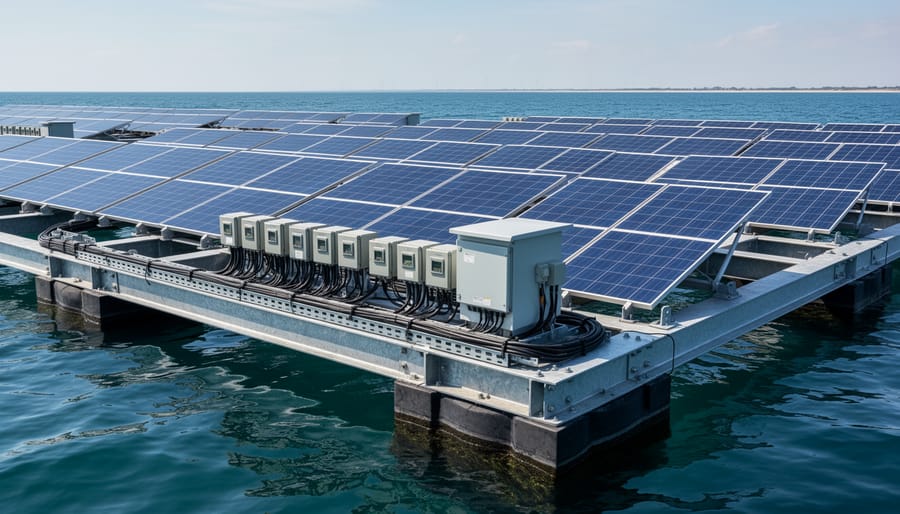
The process begins at the solar array itself, where individual panels connect to inverters mounted on the floating platform. These inverters convert the direct current electricity from the panels into alternating current, the form required by grid systems. The converted power then flows through marine-grade cables that run beneath the water surface toward shore. These cables feature multiple protective layers, waterproof insulation, armoured sheathing, and corrosion-resistant materials, to handle saltwater exposure, wave action, and potential impacts from marine traffic or wildlife.
At the shoreline, the submarine cables connect to onshore substations that step up the voltage for efficient transmission across longer distances to regional grid infrastructure. The substation also houses monitoring equipment that tracks power flow, voltage levels, and system performance in real time. Grid operators can adjust the incoming power to match demand fluctuations and ensure stable integration with electricity from other sources.
This connection infrastructure represents a significant portion of offshore solar installation costs, particularly for projects located far from shore. The cable routes require careful surveying to avoid sensitive marine habitats, shipping lanes, and existing underwater infrastructure. Installation typically involves specialized marine vessels that lay cables along the seabed, sometimes burying them for added protection in high-traffic areas.
Types and Components of Offshore Solar Systems
Floating Photovoltaic Platforms
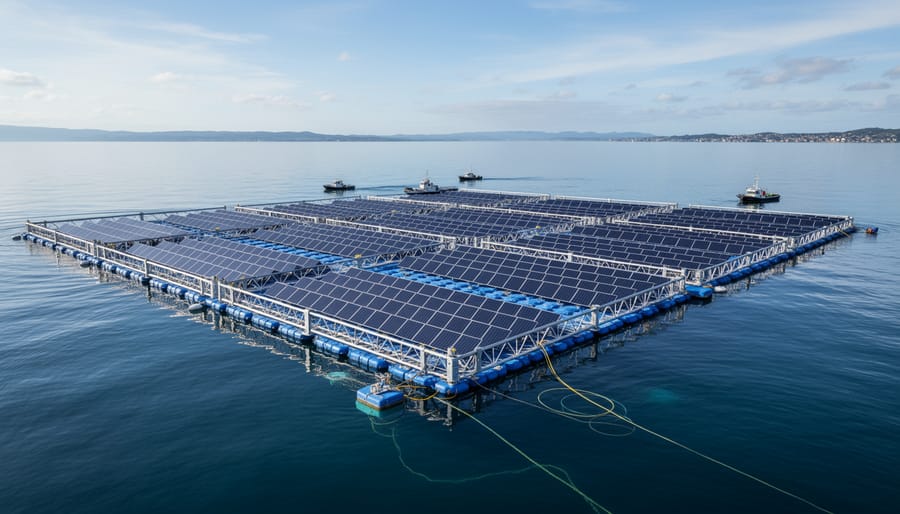
Floating photovoltaic platforms use buoyant structures designed to keep solar panels stable and functional on water surfaces. These systems typically consist of modular pontoons made from high-density polyethylene (HDPE), which resists corrosion from prolonged water exposure and UV degradation. Each floating platform supports panels at an optimal tilt angle, usually between 5 and 15 degrees, to maximize sunlight capture while minimizing wind resistance and wave impact.
The modular design allows platforms to scale from small installations on reservoirs to utility-scale arrays covering hundreds of hectares. Individual pontoons link together through connector systems that provide both structural integrity and flexibility, letting the array move with water surface variations without stressing the panels or electrical connections. Mooring systems anchor the platforms using cables attached to the lakebed or seafloor, preventing drift while allowing controlled movement.
Design variations include closed-cell foam pontoons for calmer inland waters and more robust HDPE structures with deeper displacement for coastal installations facing stronger currents and waves. Some advanced platforms incorporate tracking systems that rotate panels to follow the sun’s path, though these add mechanical complexity and maintenance requirements in marine environments. The spacing between panel rows balances energy density against maintenance access and wave penetration that prevents platform damage during storms.
Fixed Offshore Structures
Fixed offshore structures take a more permanent approach by mounting solar panels directly onto existing or purpose-built installations in coastal waters. Unlike floating platforms that ride the water’s surface, these systems anchor panels to rigid frameworks such as breakwaters, jetties, decommissioned oil platforms, or specially constructed piers extending into shallow marine environments.
This configuration offers exceptional stability in rough sea conditions, as the panels remain secured to foundations driven into the seabed or built atop concrete structures. The rigid mounting eliminates concerns about panel movement during storms and allows for more traditional installation techniques similar to land-based arrays. Maintenance crews can often access these systems via walkways or service vessels docking at the structure itself.
Breakwaters present particularly attractive opportunities since they already exist for wave protection, transforming infrastructure that serves a single purpose into dual-function renewable energy generators. Coastal industrial facilities sometimes install panels on protective sea walls or harbour infrastructure, maximizing space in congested waterfront areas. The main limitation remains water depth, these structures work best in shallower coastal zones where foundation construction remains economically viable compared to deep-water floating alternatives.
Hybrid Renewable Installations
Hybrid renewable installations combine solar panels with offshore wind turbines on unified platforms, leveraging the same marine infrastructure to capture energy from multiple sources. These dual-technology systems mount photovoltaic arrays on the platforms, foundations, or surrounding water surfaces of wind farms, maximizing the energy output per square kilometer of ocean real estate.
The complementary nature of wind and solar generation makes hybrid installations particularly efficient. Wind typically generates more power during stormy weather and nighttime hours, while solar contributes peak output during calm, sunny days. This diversification smooths overall energy production and improves capacity factors compared to single-technology installations.
Shared infrastructure significantly reduces costs. Submarine cables, maintenance vessels, grid connection equipment, and monitoring systems serve both technologies rather than requiring separate installations. Permitting processes become more streamlined when a single site hosts multiple renewable sources.
European offshore wind farms have led hybrid development, with solar panels integrated into existing turbine platforms in the North Sea. Japan has also pioneered floating hybrid systems that combine wind and solar on shared pontoons. These installations demonstrate that multi-source renewable platforms can deliver more consistent, economical power than isolated systems while minimizing ocean space requirements.
Uses and Applications of Offshore Solar Energy
Large-Scale Grid Power Generation
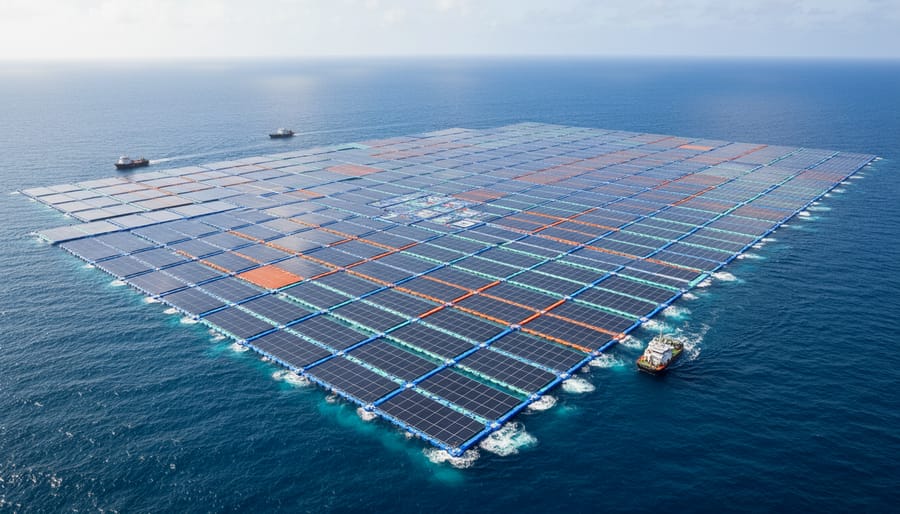
Offshore solar farms offer a practical solution for expanding renewable energy capacity in regions where available land limits traditional solar development. Countries like Singapore, Japan, and the Netherlands have turned to water-based installations to meet growing electricity demands without competing for scarce terrestrial space. These systems feed power directly into national grids through submarine cables, functioning similarly to conventional solar farms but sidestepping the land-use conflicts that often delay project approvals.
The installations prove particularly valuable in densely populated coastal areas where industrial, agricultural, and residential needs already strain land resources. A single offshore solar farm can generate hundreds of megawatts, enough to power tens of thousands of homes, while occupying water surfaces that serve multiple concurrent uses. Grid operators integrate this power alongside other renewable sources, using it to offset fossil fuel generation during peak sunlight hours.
In regions with extensive coastlines or large reservoirs, offshore solar provides scalability that complements existing energy infrastructure. The technology allows utilities to diversify their renewable portfolios beyond wind and hydroelectric sources, strengthening grid resilience while advancing decarbonization targets without requiring significant new land acquisition.
Supporting Marine Industries
Offshore solar installations provide direct power solutions for remote marine operations that traditionally relied on diesel generators or costly grid extensions. Offshore aquaculture facilities benefit particularly from this localized energy source, using solar electricity to run aerators, feeding systems, and water quality monitoring equipment around the clock. The proximity of power generation to fish farms eliminates transmission losses and reduces operational costs significantly.
Decommissioned oil platforms present another practical application. Rather than dismantling these structures entirely, developers can repurpose them as solar generation sites, supplying power to nearby marine activities or feeding electricity back to coastal grids. This adaptive reuse extends infrastructure lifespan while supporting clean energy goals.
Marine research stations stationed far from shore face persistent energy challenges. Solar arrays mounted on floating platforms or existing infrastructure provide reliable power for scientific instruments, communication systems, and laboratory equipment. These installations eliminate the need for frequent fuel deliveries, reduce noise pollution that might interfere with marine studies, and lower the carbon footprint of oceanographic research. The consistent energy supply enables continuous data collection in previously difficult-to-power locations.
Canadian Potential and Projects
Canada’s vast coastlines and extensive inland water systems present significant opportunities for offshore solar development, though the technology remains largely unexplored domestically. The country’s three ocean borders, Pacific, Arctic, and Atlantic, along with major lakes like Superior, Huron, and Great Bear, offer substantial surface area where floating solar installations could generate clean electricity without competing for valuable land. British Columbia’s sheltered coastal inlets and Ontario’s Great Lakes shorelines represent particularly promising locations due to existing grid infrastructure and proximity to population centres.
Currently, no commercial offshore solar farms operate in Canadian waters, but growing interest in renewable energy diversification and market adaptation has sparked preliminary feasibility assessments. Research institutions and energy companies have begun examining how offshore solar could complement Canada’s existing hydroelectric and wind capacity, particularly in coastal communities that rely on diesel generators. The technology’s tolerance for cold climates and potential synergy with ice-free shipping lanes during winter months adds unique Canadian considerations to global offshore solar development trends.
Advantages and Challenges
Offshore solar farms offer distinct advantages that make them attractive additions to the renewable energy mix, but they also face meaningful obstacles that developers and policymakers must navigate carefully.
The cooling effect of water represents one of the most significant benefits. Solar panels lose efficiency as they heat up, but panels mounted on water surfaces stay cooler than their land-based counterparts, often maintaining 5-10% higher performance throughout the day. This efficiency boost translates directly into more electricity generated from the same panel area. Water-based installations also avoid competing for valuable agricultural or residential land, a critical consideration in densely populated coastal regions where every square kilometre counts. In countries like the Netherlands and Singapore, where land is scarce and expensive, offshore solar opens up vast expanses that would otherwise remain unused for energy production.
Offshore systems can integrate with existing marine infrastructure, reducing total project costs. Decommissioned oil platforms, harbour breakwaters, and offshore wind installations all present opportunities for hybrid development that shares grid connections and maintenance facilities. The proximity to coastal population centres also shortens transmission distances compared to remote desert solar farms, cutting energy loss during transport.
However, the marine environment introduces challenges that drive up both initial costs and ongoing maintenance requirements. Saltwater corrosion attacks metal components and electrical connections relentlessly, demanding specialized materials and protective coatings that add 20-30% to equipment costs. Waves, storms, and strong currents create mechanical stresses that land installations never face, requiring robust anchoring systems and flexible platform designs. Installation itself is more complex and weather-dependent than terrestrial projects, with specialized marine vessels and crews commanding premium rates.
Environmental concerns require careful assessment. While floating solar can reduce water evaporation and limit algae growth in some contexts, large installations may affect local ecosystems by blocking sunlight from reaching underwater vegetation and altering water temperatures. Marine wildlife, from fish to seabirds, may be disrupted during construction and operation. These factors make environmental impact assessments and renewable energy policy frameworks essential for responsible development that balances clean energy goals with ecosystem protection.
Frequently Asked Questions
How long do offshore solar farms last?
Offshore solar installations typically have a lifespan of 25 to 30 years, similar to land-based systems, though marine environments can accelerate wear on components. Regular maintenance and corrosion-resistant materials help extend operational life in saltwater conditions.
Do offshore solar farms harm marine life?
Current research suggests minimal direct harm, with some floating platforms potentially creating shaded refuges that benefit certain fish species. However, construction activities, electromagnetic fields from cables, and habitat alteration require careful assessment and monitoring for each installation site.
Are offshore solar farms more expensive than land-based systems?
Yes, offshore installations generally cost 20 to 40 percent more due to marine-grade materials, complex installation logistics, and specialized maintenance requirements. The premium often makes sense only where land is scarce, expensive, or unavailable for development.
How often do offshore solar farms need maintenance?
Maintenance typically occurs quarterly or semi-annually, focusing on panel cleaning, mooring inspections, and electrical system checks. Weather windows, vessel access, and the need for specialized marine technicians make offshore maintenance more complex and costly than land-based operations.
These practical considerations shape deployment decisions across different regions. Countries with extensive coastlines and limited land availability often find the cost premium justified, while others prioritize terrestrial installations. In Canada, where vast land resources exist but certain coastal and northern communities face energy access challenges, offshore solar may serve niche applications rather than large-scale generation. The technology continues maturing with industry support focused on reducing installation costs, improving durability in harsh marine conditions, and developing hybrid systems that combine solar with wave or wind energy on shared platforms.
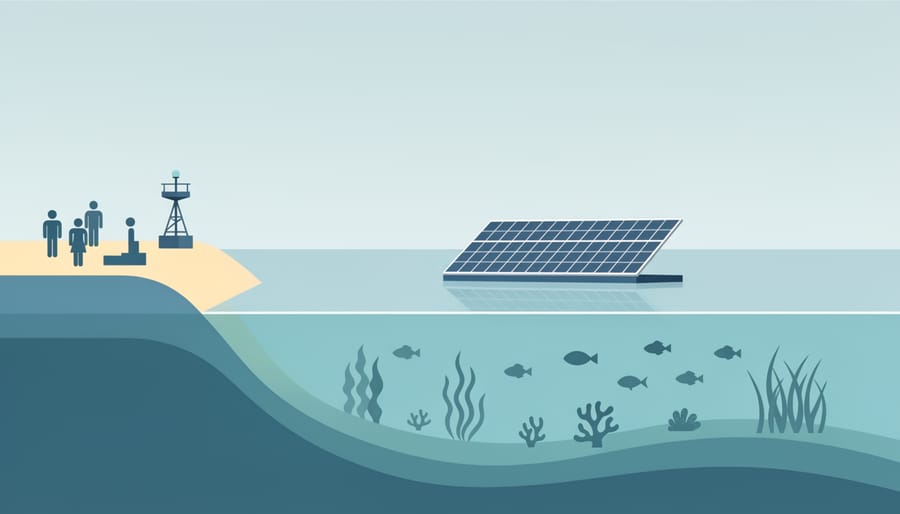
how it works
Offshore solar farms harness sunlight through photovoltaic panels positioned on water surfaces, converting solar radiation into direct current electricity. The panels rest on floating platforms or fixed structures anchored to the seabed in shallow coastal waters. When sunlight strikes the panels’ silicon cells, it creates an electrical field that generates power more efficiently than land-based systems, thanks to the natural cooling effect of the surrounding water.
The generated electricity travels through waterproof cables connecting individual panel arrays into a central collection point on the platform. From there, submarine cables transmit the power to shore-based inverters, which convert the direct current into alternating current compatible with electrical grids. Modern installations incorporate remote monitoring systems that track performance, adjust panel angles for optimal sun exposure, and detect potential issues before they affect power generation.
The water-based environment requires specialized equipment resistant to corrosion, wave action, and marine conditions. Mooring systems keep floating platforms stable while allowing for water level fluctuations, and breakwater designs protect panels from harsh weather. This technology represents a growing segment of Canadian clean energy innovation, particularly for regions with limited available land but abundant water resources.
Offshore solar farms represent a promising frontier in renewable energy, expanding the possibilities for clean power generation beyond land-based constraints. As countries worldwide grapple with increasing electricity demands and limited suitable terrain, these water-based installations offer a practical solution that combines solar technology with unused aquatic spaces.
The integration of offshore solar systems with emerging grid technologies creates opportunities for more resilient and diversified energy networks. Floating platforms and fixed structures in coastal waters can work alongside wind farms, battery storage, and traditional generation sources to provide reliable power when and where it’s needed most.
For Canada, the technology holds particular significance. With extensive coastlines and vast inland waterways, the country possesses ideal conditions for offshore solar development. While projects remain in early stages compared to global leaders, the potential to harness these resources could meaningfully contribute to national climate goals without competing for valuable agricultural or forested land.
The path forward will require addressing technical challenges around marine durability, environmental stewardship, and economic viability. Yet as technology advances and costs decline, offshore solar farms are positioned to become a valuable component of the clean energy transition, turning Canada’s abundant water resources into productive renewable energy assets.